
Modern web design
Published: April 9, 2026
For many companies, the website is the first “trust test” customers run often before they ever talk to sales. That’s why design is not just visual polish: usability and speed affect engagement and conversion outcomes. Slow experiences are correlated with abandonment and lost revenue opportunities.
Custom web design means your site is shaped around your business model, brand, and user journeys. Templates and AI builders can launch fast, but they typically start from generic structure making it harder to communicate what’s unique about your company and to support real customer decision paths.
AI is still useful (ideation, drafts, variations), but major platforms emphasize “value to users” over the method of creation. Automation without editorial oversight can produce thin, repetitive experiences and at scale that can conflict with quality/spam policies. The same logic applies to design: generically assembled pages often fail to deliver a differentiated, user-first outcome.

Key principles
Custom design works best when it is goal-driven. You start by defining primary conversions (leads, purchases, bookings), target segments, and trust signals then build information architecture and content hierarchy around that. This aligns with widely used service-design thinking: start with user needs and evidence, not assumptions.
A second principle is content-first structure: navigation, headings, and page hierarchy should make the offer understandable in seconds. Templates often look polished but bury what matters, because they optimize for “demo content” rather than your real messaging.
Third: design systems for businesses. Consistent components, tokens, and patterns reduce design debt and make future updates faster. That’s why many high-performing organizations publish and maintain design systems, turning design from a one-off project into a reusable capability.
UX/UI best practices
A practical way to pressure-test UI decisions is to use proven usability heuristics (visibility of system status, consistency, error prevention, recognition over recall, etc.). AI-assembled layouts and “drag-and-drop” template builds often miss these details—especially for forms, navigation states, feedback, and error handling.
Custom design is where UX becomes business-specific: you can map your real customer questions to page structure, remove unnecessary steps in lead funnels, and build interaction patterns that match how your audience buys (B2B vs B2C, high-consideration vs impulse). Templates rarely match a company’s actual sales process; custom design can.
Responsive & accessibility
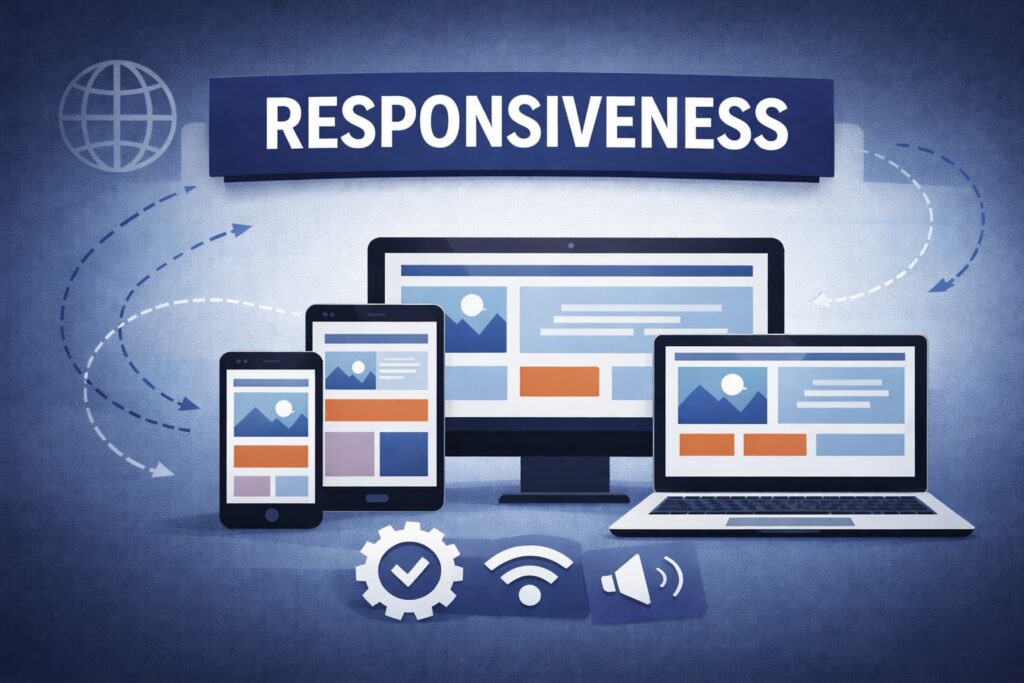
Responsive design is a baseline, not a feature. Google explicitly recommends responsive web design as an easier pattern to implement and maintain, and mobile-first indexing is the default reality of crawling and search.
Accessibility is also foundational. WCAG organizes accessibility around four core principles (Perceivable, Operable, Understandable, Robust). Beyond compliance, accessible design expands your reachable market and improves usability in real-world constraints. Globally, a large share of the population experiences significant disability designing inclusively has practical impact.
In Croatia and across the EU, accessibility obligations are particularly clear in the public sector, and broader product/service accessibility requirements increase the relevance for private businesses in certain categories (such as digital services and e-commerce). Treat accessibility as an engineering and design requirement not a last-minute widget.
Visual design & branding
Brand design is experienced through clarity, consistency, and credibility not just a logo. Custom design gives you control over typography, spacing, imagery, and micro-interactions so the site feels unmistakably “yours,” rather than a recognizable template.
Accessibility-aware visual design matters too. For example, contrast requirements (such as 4.5:1 for normal text at WCAG AA) directly influence readability and inclusiveness, and should be part of your design system so every new page stays compliant by default.
Performance & SEO considerations
Performance is part of user experience and is strongly connected to business outcomes. Core Web Vitals thresholds commonly referenced are LCP ~2.5s, INP ~200ms, CLS ~0.1 use them as engineering targets, not vanity scores.
Templates often ship extra code and third-party dependencies, increasing render-blocking resources and unused JS/CSS. Lighthouse and DevTools Coverage help detect these issues, but the best results come from designing and building with performance budgets from day one.
On the SEO side, fundamentals remain decisive: clear site architecture, internal linking, sitemaps, robots controls, and structured data where it adds meaning. For bilingual sites, implement language variants correctly (for example with hreflang) so search engines understand localized equivalents.
Tools & workflow
Custom design is best treated as a repeatable workflow: discovery → IA → wireframes → UI → prototype → build → QA → launch → optimize. Iteration and measurement matter: web performance guidance explicitly discusses connecting speed improvements to business metrics via experimentation and A/B testing.
For ongoing quality, use audit tooling (Lighthouse, PageSpeed Insights), accessibility checks (contrast testing, WCAG mapping), and regression prevention (repeat audits in CI). The goal is reliable improvement, not “perfect scores.”
Case study examples or portfolio highlights
The GOV.UK Design System is a strong reference point for consistency, research-led patterns, and accessibility strategy across large service ecosystems.
The NHS Design System explicitly focuses on building consistent, accessible services and tracks WCAG-related updates showing how design evolves as standards evolve.
In the private sector, Carbon (IBM), Atlassian Design, and Shopify’s Polaris demonstrate how mature teams standardize components and documentation to ship faster with fewer inconsistencies illustrating what “custom” looks like at scale.
Conclusion
If your website is a growth channel, custom web design is a competitive investment: clearer positioning, better UX, stronger performance, and a foundation for SEO and accessibility. Templates and AI can accelerate early stages, but they rarely deliver a durable, differentiated business asset without expert direction and testing.
If you want a modern web design that showcases your brand and adds value to your company, contact us, we specialize in creating websites in Pula and Istria.
New web is waiting for you
We turn your website visitors into euros. Contact us and increase your profits today!